What really goes on behind those too good to be true fashion prices, underpaid workers and an increased carbon footprint? Fast fashion has it all.
From a young person’s perspective, buying from fast fashion brands such as Boohoo, Missguided or Pretty Little Thing seems the easiest and cheapest way to get stylish clothes delivered to their door. It bears the question as to whether sustainability even enters their thought process when buying new clothes. Speaking to a focus group of students, fast fashion’s perfect customers, it seems this isn’t the case.
Out of the 9 students in the group who buy from online fast fashion brands, 8 admitted that they do not think of sustainability when shopping online. I also asked for the students’ reasoning behind their online shopping and these were the results:
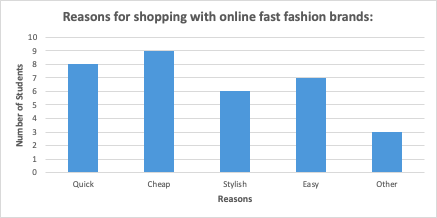
As shown by the bar chart, the main reason students choose to shop with these brands is because they are quick, cheap, stylish and easy. These results are unsurprising to me as it doesn’t take much research to find extremely cheap clothing on these websites. A quick Google search or click onto their apps, sites such as Missguided waste absolutely no time in grabbing your attention with new deals, sales and discount codes.
The most popular reasoning behind shopping from these sites was the price. Nine of the students chose this as one of their reasons. Again, it is unsurprising that this was a popular choice, as for example Pretty Little Thing have a “£5 dresses” section of their website.
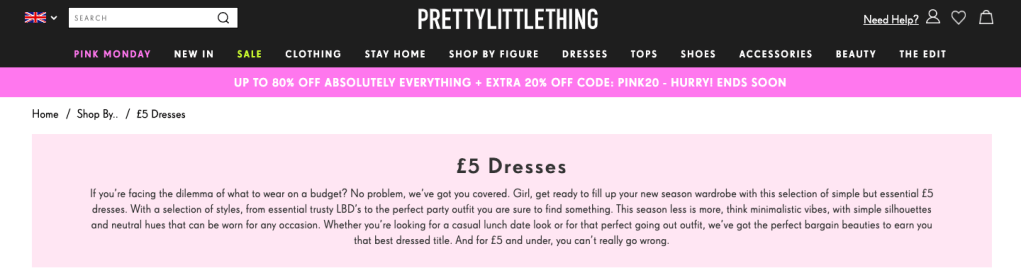
With £5 sections and added discount codes, also shown in the website screenshot above, prices can get obscenely low. This is without mentioning that these websites also have permanent sale sections, not just for when the new season collections come in, which is how sales were typically done in the past. These sale sections have thousands upon thousands of discounted products, from jewellery and bags to dresses and skirts. These companies also waste no time in creating new opportunities for a sale, in the months leading to Christmas the usual sale to look out for is the “Black Friday” sale. However, this year has seen the introduction of “Pink Friday”, another opportunity for a sale, just one week before Black Friday.
This “Pink Friday” saw prices for clothes reach new lows, Pretty Little Thing’s sale featured hundreds of items priced from just 5p. A coat previously priced at £45 was reduced to just 45p, while a once £25 jumper was on sale for 25p. This begs the question, how are these prices even possible?
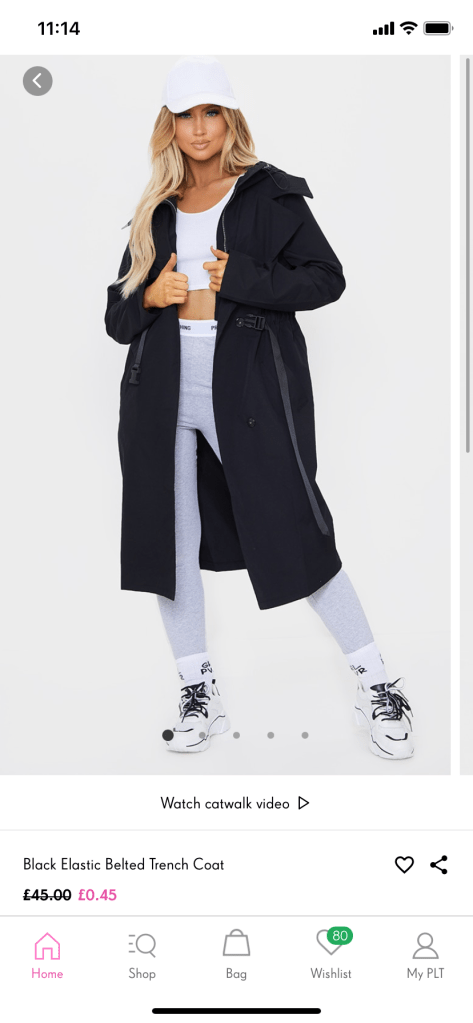
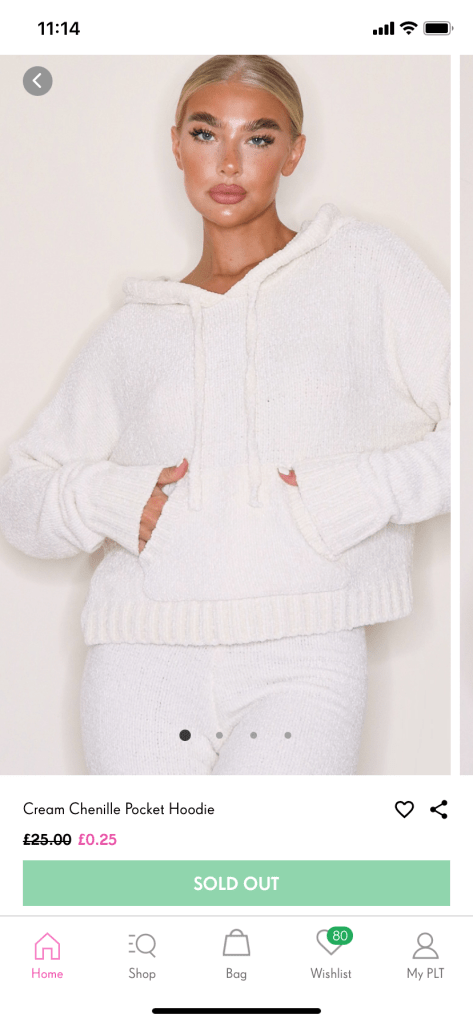
Pretty Little thing were not the only site to be offering huge discounts, MissPap and Femme Luxe Finery were also among the many offering clothes for below £1.
The second most popular reasoning behind shopping with fast fashion brands was the speed. All of these companies offer next day delivery, whether that’s for an added price or for free when you spend a certain amount of money. A common feature for these websites is also paying a discounted price for a years’ worth of free next day delivery, arguably encouraging customers to buy more often so they get their money’s worth of delivery. Pretty Little Thing offer unlimited next day delivery for a year for just 83p a month, advertised as “faster fashion”.
But these companies are not just quick in delivery, they waste absolutely no time in getting the latest trends and designs readily available for us to buy. The “Inside Missguided: Made in Manchester” documentary makes clear just how fast these companies work to get the newest fashion onto their websites. The documentary was arguably portrayed in the manner that the only thing that mattered to the business was speed and money, rather than morals and ethics, “is there any way we could get it any quicker?” “When we create designs, we have to get them on sale rapid. Three days after seeing Sofia Richie wear a dress on Instagram, Vicky’s designed our brands version.” Missguided’s fashion buyers were also documented “haggling” items of clothing down to the last penny and “driving a hard bargain.”
“Speed is so important.”
But why is fast fashion a problem?
Fast fashion raises lots of questions about its ethics and morals, from factory conditions to its carbon footprint.
150 billion pieces of clothing end up in landfill each year while it takes 1000 years for a single shoe to decompose. The fast fashion industry also uses 5 times more CO2 than the aviation industry yearly and also uses 2.5 trillion gallons of water each year. A memorable example of the devastating effects of this industry is the disappearance of the Aral Sea, revealed on a “Stacey Dooley Investigates” episode. Stacey was driven across the land, which was once a seabed, however after the region was used for cotton production, it’s now dry land. To emphasise just how large the sea once was, it took over three hours for them to drive across it. “There used to be fish; now there’s a camel”.
https://www.bbc.co.uk/programmes/p06n27x3
Not only is fast fashion the 2nd biggest contributor to global warming, the conditions of its workers in factories has always been a concern. An undercover report by The Sunday Times recently revealed that factory workers making clothes for Boohoo’s brand “Nasty Gal” in their Leicester factory were being payed as little as £3.50 an hour, way below the legal minimum wage. The report also reveals that during the coronavirus pandemic, their workers weren’t given sufficient safety measures such as no social distancing within the factory.
This problem is not going away fast, over lockdown online giant ASOS revealed record profits, as their usual sales quadrupled. They gained another 3 million customers to their already huge customer base of over 20 million. These figures perhaps show that without the option to shop sustainably as charity and second-hand shops were closed, young people will turn to fast fashion. This emphasises the quick, cheap and reasons for shopping with fast fashion brands.
So, what next?
Speaking to Olivia Pinnock, founder of The Fashion Debates as well as fashion lecturer, speaker and journalist, she says there is hope for the fashion industry to become more sustainable. “The big companies have loads of money, let’s not let them off the hook here. When you’re in a business model that is constantly working towards profit and growth, you sit there and think can they afford to do this? Of course, they can!”
When asked what students or young people can do to change their habits, Olivia responded, “I totally appreciate that we all want to look good, we all enjoy fashion and expressing ourselves, there’s nothing wrong with that at all. A really good tip is to think about what is encouraging you to maybe make purchases you wouldn’t otherwise make; can you unfollow brands on social media and block ads off?”
“Immerse yourself”.
 Preedy Posts